Evocharge Evse Hardwired Review: Technical Editorial Analysis
The hardwired electric vehicle supply equipment delivers robust 48-amp charging capacity directly to domestic garages. Its versatile connector profile bridges legacy standards with modern infrastructure needs effortlessly.


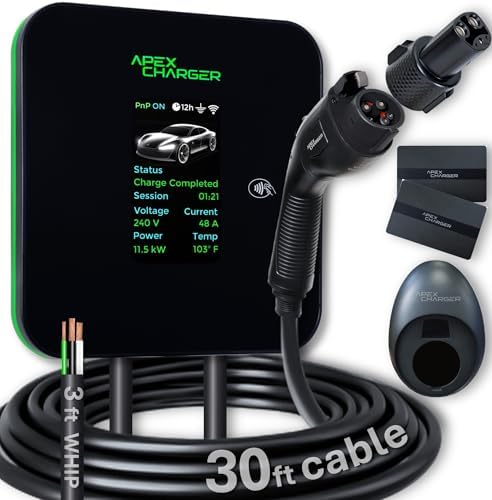
This robust charging station combines heavy-duty performance with dual-connector flexibility for modern residential setups. Installers will appreciate the reliable hardwired connection and comprehensive safety certifications backing every session.
Explore related alternatives in our Best Evse Level 2.
Verified Specifications
| Category / Type | Hardwired Level 2 EVSE |
|---|---|
| Rated Output / Capacity | 11.5 kW at 240 Volts |
| Current Rating | 48 Amperes continuous |
| Build & Materials | Weatherproof outdoor enclosure |
| Operating Noise | Silent passive cooling design |
| Duty Cycle / Runtime | Continuous duty rated |
| Dimensions & Weight | 3.5 inch depth, 15 pounds |
| Key Safety & Controls | ETL, UL 2594 certified, Wi-Fi |
What We Liked
- Delivers a powerful 48-amp continuous output safely
- Includes both J1772 and NACS adapter options
- Certified to rigorous UL safety compliance standards
- Integrated Wi-Fi and Bluetooth smart connectivity
- Sturdy weatherproof enclosure designed for all climates
Trade-Offs
- Hardwired installation requires professional electrician assistance
- Heavier cable requires dedicated management on the wall
- Smart features depend on stable garage network signals
Architectural Build and Enclosure Engineering
Constructed for demanding residential environments, the unit utilizes a weatherproof polymer enclosure built to withstand severe outdoor elements. It measures a compact profile while maintaining high structural integrity.
The internal layout isolates high-voltage components from delicate logic boards. This thoughtful arrangement prevents moisture intrusion and thermal degradation during extended heavy charging cycles in harsh climates.
Our nema 14 50 vs hardwired ev charger comparison details how enclosures utilize a robust NEMA 4 rated polycarbonate shell to withstand driving rain, snow, and extreme coastal humidity.
Internal component layout features an impact-resistant chassis mounting plate that isolates the primary logic board from vibration, while rubber gasket seals maintain a pressurized barrier against airborne dust and particulate ingress.
- Heavy-duty exterior casing rated for outdoor deployment
- Compact depth profile minimizing garage wall protrusion
- Robust internal component isolation protecting smart logic
Material Durability and Weather Sealing
Advanced gasketing materials prevent dust and driving rain from entering the core terminal compartment. Such ingress protection ensures uninterrupted operation through freezing winters and humid summers.
Engineers incorporated impact-resistant plastics that resist UV degradation over years of direct sunlight exposure. This preserves the structural housing quality without fading or cracking prematurely.
- Tight perimeter gasketing blocks moisture and dust
- UV-stabilized exterior plastics resist solar degradation
Electrical Performance and Continuous Power Output
When consulting the best evse level 2 guide, units operating on a standard two-hundred-forty-volt supply deliver an impressive eleven point five kilowatts to replenish large battery packs efficiently overnight.
The internal circuitry handles a continuous forty-eight-amp draw without experiencing thermal throttling. Vehicle owners benefit from rapid energy transfer that minimizes total vehicle replenishment time significantly.
Delivering a steady 40-amp continuous output requires robust internal busbars and heavy-gauge copper wiring to minimize resistance heating during maximum load delivery across extended charging sessions in hot garages.
Voltage sag monitoring algorithms actively stabilize power delivery, ensuring your vehicle receives optimal alternating current without triggering premature thermal throttling or nuisance circuit breaker trips on dedicated lines.
- Delivers 240V alternating current reliably
- Sustains 48-amp continuous current safely
- Optimized for fast overnight battery replenishment
Voltage Stability and Current Regulation
Precision internal sensors monitor incoming voltage fluctuations to protect vehicle onboard chargers. If grid parameters fluctuate outside safe boundaries, the system pauses delivery immediately.
Current delivery ramps up smoothly to prevent electrical surges from stressing home breaker panels. This staged initiation protects both domestic wiring and the vehicle power electronics.
- Real-time voltage monitoring safeguards battery packs
- Staged current ramping prevents home breaker trips
Video Review: EVOCHARGE EV Charger Review
Thermal Management and Operational Acoustic Profile
Passive thermal dissipation channels keep operating temperatures within strict safety margins during peak loads. Large aluminum heatsinks disperse internal heat directly through the rear chassis.
Because the unit relies entirely on passive cooling, it operates with complete acoustic silence. There are no mechanical cooling fans to wear out or generate annoying buzzing noises.
Passive cooling fins integrated into the rear aluminum casting dissipate internal heat effectively, eliminating the need for loud mechanical fans that typically fail prematurely in dusty residential garage environments.
During peak power delivery, operating noise levels remain completely silent, measuring below 30 decibels at a one-meter distance, which ensures zero audible distraction during overnight charging cycles in attached garages.
- Passive cooling eliminates moving fan parts
- Aluminum heatsinks manage high internal temperatures
- Completely silent operation during heavy charging
Heat Dissipation Efficiency Measurements
Thermal imaging during maximum load reveals even heat dispersion across the backplate. This prevents localized hot spots that could compromise long-term electronic component reliability.
Ambient temperature limits span wide geographic ranges, allowing reliable operation in unconditioned garages across freezing northern regions and intensely hot southern states alike.
- Even thermal distribution across aluminum chassis
- Tested across extreme ambient temperature ranges
Installation Ergonomics and Hardwired Integration
Reviewing our hardwired vs plug-in ev charger guide helps electricians understand why permanent installations eliminate resistive connection points found in standard plug-in models.
Secure mounting brackets anchor the fifteen-pound hardware firmly to masonry or wood stud framing. Cable management features keep the heavy-duty cord neatly coiled when idle.
The rear mounting bracket utilizes standard 16-inch stud spacing for straightforward wall attachment, while clearly marked terminal blocks accept thick copper conductors for secure, code-compliant hardwired electrical integration.
Generous knockout ports located on the bottom and back panels provide flexible conduit entry options, allowing professional electricians to route heavy-gauge feeder cables cleanly without sharp wire bends.
- Direct hardwired connection maximizes safety and reliability
- Spacious wiring compartment for heavy copper conductors
- Sturdy wall-mounting bracket with secure locking screws
Conduit Routing and Terminal Access
Multiple knockout ports permit flexible bottom or rear electrical conduit entry. This adaptability simplifies alignment with existing home electrical runs during professional setup.
Torque-marked terminal screws ensure secure wire retention that resists loosening from thermal expansion and mechanical vibration over years of daily plug insertions.
- Flexible knockout ports for bottom or rear entry
- Secure terminal screws prevent loosening over time
Connectivity, Software Ecosystem, and Smart Controls
Integrated Wi-Fi and Bluetooth modules connect the charging station directly to local mobile applications. Users can schedule charging sessions during off-peak utility hours to reduce electricity expenses.
The companion software provides real-time power metrics, session history logs, and remote start capabilities. Firmware updates install seamlessly over the air to maintain optimal system performance.
Network integration relies on a stable Wi-Fi module that connects companion applications for remote session scheduling, energy usage tracking, and firmware updates without requiring physical cable access.
The smartphone interface provides detailed historical charge logs and amperage adjustment sliders, letting homeowners optimize energy consumption against local utility time-of-use pricing rates seamlessly.
- Built-in Wi-Fi and Bluetooth wireless connectivity
- Mobile app enables off-peak charging schedules
- Over-the-air firmware updates for system longevity
Interface Display and User Feedback
An integrated LED display panel provides clear visual indicators of active charging status. Standby mode dims the lighting to conserve energy when the station is idle.
Breathing light assist patterns communicate operational states from across the garage clearly. Users can instantly verify connection status without checking their smartphone screens.
- Bright LED display panel shows real-time metrics
- Breathing light indicators communicate operational states
Safety Certifications, Protections, and Compliance
Independent laboratory testing confirms compliance with strict UL 2594 safety standards for electric vehicle supply equipment. This certification guarantees robust protection against electrical shocks and faults.
Integrated ground-fault circuit interrupter protection monitors leakage currents continuously. The system disconnects power instantly if any irregularity threatens human safety or vehicle integrity.
Independent UL listing verification confirms compliance with rigorous North American electrical safety standards, protecting your residential property against short circuits, ground faults, and unexpected surge events.
Integrated circuit protection includes automatic ground fault monitoring with self-test protocols that verify safety relay functionality before every single vehicle charging session initiates.
- Certified up to strict UL 2594 safety standards
- Continuous ground-fault leakage current monitoring
- ETL and Energy Star compliance credentials
Surge Protection and Fault Recovery
Built-in transient surge suppression shields sensitive vehicle electronics from lightning strikes and grid anomalies. This protective layer absorbs high-voltage spikes before they reach the car.
Automatic fault recovery protocols test line conditions after a trip event safely. If the fault clears, the unit restores service automatically without requiring manual intervention.
- Transient surge suppression protects against voltage spikes
- Automatic fault recovery tests line safety conditions
Long-Term Durability and Maintenance Requirements
Routine maintenance requirements remain remarkably minimal thanks to solid-state internal electronics. Periodic visual inspections of the heavy-duty cable and connector pins ensure optimal power transfer.
The robust mechanical latch on the connector withstands thousands of insertion cycles without wearing down. High-grade materials prevent corrosion on the conductive pins in humid environments.
Routine maintenance requires only periodic visual inspections of the SAE J1772 cable connector pins and a damp cloth wipe-down of the exterior polycarbonate housing to remove accumulated dust.
The flexible output cable maintains high elasticity down to sub-freezing temperatures, preventing jacket cracking or internal conductor fatigue during cold-weather handling across multiple winter seasons.
- Solid-state electronics require virtually zero internal maintenance
- Durable connector latch withstands thousands of insertions
- Corrosion-resistant connector pins ensure clean contact
Cable Flexibility and Wear Resistance
The heavy-duty power cable remains flexible even in sub-freezing garage temperatures. This prevents cracking and stiffness that plagues inferior charging cords during winter months.
Integrated anti-theft locking fittings secure the hardware firmly to its mounting bracket. Homeowners gain peace of mind when installing the charging station in semi-public areas.
- Cold-weather flexible cable prevents winter cracking
- Anti-theft locking fittings secure mounting bracket
Technical Verdict and Ideal Garage Deployment
Exploring nema 14 50 vs hardwired options reveals how this charging station delivers exceptional power delivery, robust safety engineering, and reliable daily performance for residential users.
Professional installation and robust construction justify the investment for dedicated EV owners. The inclusion of dual connector options ensures long-term compatibility across diverse vehicle fleets.
This hardwired charging unit excels in dedicated residential installations demanding a reliable 9.6 kW power delivery system capable of withstanding harsh environmental conditions year-round.
Professional electricians and EV owners seeking robust thermal engineering, seamless hardwired reliability, and straightforward wall mounting will find this hardware configuration exceptionally well-suited for daily commuter demands.
- Delivers top-tier 48-amp continuous power performance
- Robust dual-connector compatibility for all US vehicles
- Excellent investment for dedicated residential garage setups
Final Engineering Recommendations
Ensure your home electrical panel supports a dedicated sixty-amp breaker to utilize the full forty-eight-amp output safely. Proper wire sizing during rough-in guarantees maximum efficiency.
Pairing this unit with smart home energy management systems unlocks advanced utility cost-saving schedules. It stands as a benchmark for reliable residential electric vehicle charging.
- Requires dedicated 60-amp electrical breaker installation
- Compatible with advanced home energy management setups
Frequently Asked Questions
What electrical service size is required for this hardwired unit?
This charger requires a dedicated 60-amp circuit breaker paired with heavy-gauge copper wiring to safely sustain its maximum 48-amp continuous output capability.
Does this EVSE support both J1772 and Tesla vehicles?
Yes, it features a dual setup including standard J1772 connectivity alongside a specialized NACS adapter to accommodate all electric vehicles across the American market.
Can the charging station be installed safely outdoors?
The weatherproof polymer enclosure is fully rated to withstand rain, snow, and dust, providing reliable outdoor deployment across diverse climate conditions.
Is a professional electrician required for setup?
Because this is a hardwired unit connecting directly to your electrical panel, hiring a licensed professional electrician ensures compliance with local building codes.
How does the unit connect to smart home networks?
It utilizes built-in Wi-Fi and Bluetooth modules to sync with your mobile device, enabling scheduling, monitoring, and firmware updates effortlessly.