How Ocpp Protocol Communicates With Home Ev Chargers
Understanding the open charge point protocol requires analyzing data packets, structured JSON payloads, and secure network sockets operating between residential charging hardware and remote central management servers.

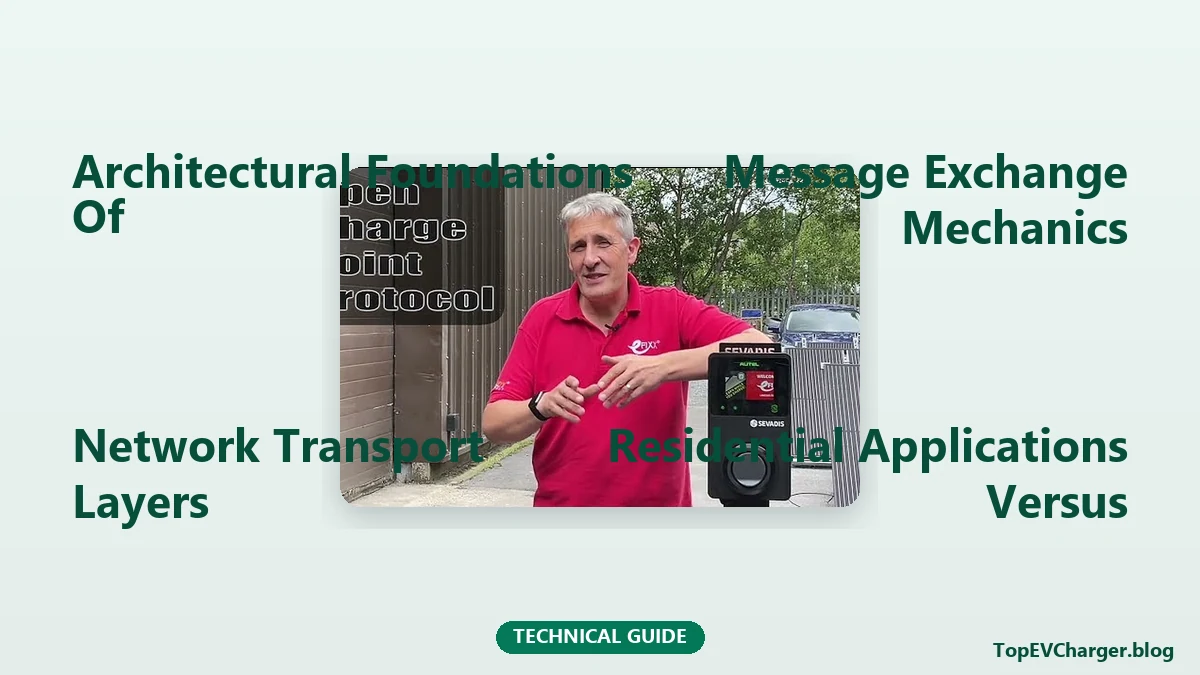
The protocol uses WebSocket secure connections and structured JSON messages to reliably translate remote server commands into local electric vehicle supply equipment hardware actions seamlessly.
Looking for matching picks? See our Best Type 2 Ev Home Charger.
Practical Quick-Reference Table
| Scenario / Metric | Recommended Target | Why It Matters |
|---|---|---|
| Network Transport | WebSockets Secure (WSS) | Encrypts data packets and secures cloud links. |
| Payload Format | JavaScript Object Notation (JSON) | Ensures universal cross-platform data parsing compatibility. |
| Heartbeat Interval | 60 to 300 seconds | Verifies persistent connection health without network congestion. |
| Security Standard | TLS 1.3 Encryption | Prevents unauthorized interception and cyber intrusion vectors. |
| Protocol Version | OCPP 2.0.1 or latest | Supports advanced smart charging and ISO 15118 standards. |
| Load Management | Dynamic Amperage Adjustment | Protects main residential service panels from overloads. |
Architectural Foundations of Open Charge Point Standards
Residential charging hardware relies on standardized communication interfaces to link local power controllers with remote cloud servers, utilizing the Open Charge Point Protocol for interoperable device management.

Physical Ethernet ports or Wi-Fi modules establish the initial network link, allowing units selected in our best ocpp chargers guide to register securely with standard backend platforms.
Once registered, the device maintains a persistent communication channel, ensuring that heartbeat signals flow continuously between the residential hardware and the remote management software architecture.
This persistent connection eliminates polling delays, enabling instant transmission of charging authorization requests, meter values, and firmware status updates across the residential local area network boundary.
- Establish stable internet connectivity via Ethernet or secure Wi-Fi channels.
- Register hardware using unique station identifiers assigned by software providers.
- Maintain continuous heartbeat intervals to verify active connection states.
- Monitor local power metrics for real-time cloud reporting accuracy.
Establishing Network Handshakes
The initial handshake process requires valid security certificates installed on the hardware to authenticate the server before any telemetry data streams across the local network interface.
Network administrators must configure outbound firewall rules to permit WebSocket traffic over secure ports, ensuring uninterrupted communication packets reach the designated cloud management infrastructure safely.
- Verify outbound port configurations on residential routers.
- Install valid TLS certificates for secure server validation.
Message Exchange Mechanics and Data Payload Formatting
Communication relies heavily on structured text payloads formatted as JavaScript Object Notation strings, allowing diverse charging hardware models to exchange standardized operational data with cloud platforms.
Every command request includes an Action name, a unique Call ID, and specific parameter arguments required to execute functions like remote start, stop, or profile adjustments.
When the charger receives a payload, its internal microcontroller parses the JSON structure, while tools like our EV charger sizing calculator help determine proper power draw parameters.
Response messages return immediately to the server, containing status confirmations, error codes, or requested diagnostic parameters formatted strictly within the defined schema specifications.
- Format all data packets using valid JavaScript Object Notation strings.
- Include unique Call IDs to track asynchronous command requests.
- Parse incoming payloads via internal microcontroller firmware routines.
- Transmit rapid status confirmations back to central management servers.
Parsing Call and Result Messages
Asynchronous communication frameworks demand precise message sequencing, where every request message must receive a matching response payload bearing the identical Call ID string value.
Firmware developers implement strict validation filters to drop malformed JSON packets instantly, preventing buffer overflows or memory corruption risks on embedded residential charging equipment.
- Match response payloads with original request Call IDs.
- Drop malformed packets using strict syntax validation filters.
Video Walkthrough: What is OCPP?
Network Transport Layers and Security Handshakes
Secure data transmission depends on robust transport layer security protocols protecting every packet traversing public internet connections between the residential charger and the cloud database.
The protocol primarily operates over WebSockets Secure, wrapping standard HTTP communication inside an encrypted TLS tunnel to prevent interception, tampering, or unauthorized remote access attempts.
Client authentication verifies the identity of the physical charging hardware using pre-installed digital certificates, ensuring rogue devices cannot impersonate legitimate residential units on the network.
Encryption keys rotate periodically according to strict cryptographic standards, a security practice examined closely inside our ChargePoint Home Flex review to protect home energy networks from cyber threats.
- Encrypt all transit data using Transport Layer Security standards.
- Utilize WebSockets Secure for persistent, bidirectional tunnel creation.
- Authenticate hardware endpoints via secure digital certificate installation.
- Protect residential local networks from external cyber intrusion attempts.
Managing TLS Certificate Lifecycles
Root certificates embedded during manufacturing authenticate the server during initial connection setups, while device certificates prove hardware legitimacy to the central management software platform.
System administrators must monitor certificate expiration dates closely, deploying automated renewal routines to prevent sudden communication dropouts caused by expired cryptographic credentials.
- Embed root certificates securely during factory manufacturing phases.
- Deploy automated renewal routines before certificate expiration dates.
Residential Applications Versus Commercial Deployment Needs
While commercial sites manage thousands of stalls with complex payment processing, residential applications focus on energy monitoring, scheduled charging windows, and solar integration capabilities.

Homeowners utilize protocol features to track kilowatt-hour consumption, optimize charging schedules during off-peak utility rates, and integrate surplus photovoltaic generation into vehicle battery storage systems.
Management platforms for residential users typically simplify administrative overhead, hiding complex backend telemetry behind intuitive mobile applications designed for single-family household environments.
Local load management rules prevent total household electrical service panels from overloading, as highlighted in our detailed Tesla vs ChargePoint comparison when home energy consumption spikes.
- Focus residential software profiles on utility rate optimization.
- Track kilowatt-hour consumption accurately for household energy reporting.
- Integrate surplus solar photovoltaic generation into vehicle charging.
- Prevent main service panel overloads via dynamic load management.
Configuring Household Load Limits
Current transformers installed at the main electrical breaker panel measure total home electrical draw and transmit real-time amperage metrics to the smart charging controller.
If household demand approaches the service rating, the management system reduces the EV charging current dynamically via protocol commands until total power draw stabilizes safely.
- Install current transformers at main electrical breaker panels.
- Adjust charging amperage dynamically during peak household demand.
Protocol Version Comparison and Functional Evolution
Older protocol iterations established basic remote start and meter reporting functions, whereas modern versions introduce advanced smart charging profiles, security enhancements, and device diagnostic routines.
The transition from legacy versions to version 2.0.1 brought native support for advanced display screens, ISO 15118 plug-and-charge capabilities, and granular device health monitoring capabilities.
Backward compatibility remains challenging, requiring firmware updates or protocol translation gateways when older residential hardware must connect to modern, feature-rich cloud management software platforms.
Selecting the appropriate version ensures long-term hardware utility, matching device firmware capabilities with the advanced feature sets demanded by modern smart grid energy programs.
- Upgrade legacy firmware to support modern smart charging profiles.
- Leverage advanced security enhancements found in newer protocol iterations.
- Implement ISO 15118 standards for seamless plug-and-charge workflows.
- Match hardware protocol versions with cloud platform software requirements.
Evaluating Firmware Compatibility Levels
Hardware manufacturers publish detailed release notes outlining specific protocol message support, helping technicians verify whether a residential charger can execute complex smart grid commands.
Testing communication parameters on a local bench setup before final wall mounting prevents frustrating compatibility failures during live cloud platform integration procedures.
- Review manufacturer release notes for specific message support.
- Test communication parameters on a bench setup beforehand.
Diagnostic Troubleshooting and Remote Management Routines
When communication failures occur between residential chargers and cloud servers, technicians rely on standardized diagnostic commands to inspect internal error logs and network status parameters.
Remote diagnostic routines allow support teams to trigger software reboots, retrieve log files, and test server connectivity without requiring physical on-site equipment inspections.
Heartbeat interval failures or invalid authentication responses typically indicate misconfigured router ports, expired security certificates, or intermittent local internet service provider connectivity drops.
Analyzing structured error codes returned by the hardware accelerates root-cause identification, minimizing downtime and restoring seamless cloud connectivity for the residential charging station quickly.
- Execute remote diagnostic commands to inspect internal error logs.
- Retrieve system log files without physical on-site visits.
- Analyze structured error codes to identify root network causes.
- Verify local internet provider stability during troubleshooting phases.
Inspecting Error Codes and Log Files
Detailed log files capture timestamped network events, WebSocket state transitions, and JSON parsing errors, providing essential debugging data for advanced technical support specialists.
Extracting these logs via local diagnostic ports or remote cloud interfaces helps pinpoint exact communication breakdown points during complex network integration troubleshooting workflows.
- Capture timestamped network events in detailed system logs.
- Extract debugging data via local or remote diagnostic interfaces.
Integration Boundaries for Residential Energy Systems
Connecting home charging equipment to broader energy management systems requires adhering to strict protocol standards that govern data exchange and device control hierarchies.
Smart home hubs and utility demand response programs utilize standardized messaging to command vehicle charging pauses or power reductions during grid emergency events seamlessly.
These integration boundaries ensure that third-party energy management software cannot compromise home electrical safety or override critical local circuit breaker protection parameters.
Standardized command validation rules verify every incoming instruction against local hardware limits, maintaining absolute operational safety across the entire residential power distribution ecosystem.
- Adhere to strict protocol standards for home energy integration.
- Respond to utility demand response commands during grid emergencies.
- Protect local circuit breaker parameters from third-party overrides.
- Verify incoming instructions against hardware safety limits continuously.
Securing Third-Party API Bridges
Application programming interfaces bridge cloud management platforms with home automation software, requiring token-based authentication and rate limiting to prevent unauthorized system access.
Developers must secure API endpoints against injection attacks, ensuring that smart home commands remain authenticated and compliant with established safety communication protocols.
- Implement token-based authentication for third-party API bridges.
- Protect endpoints against injection attacks and unauthorized access.
Frequently Asked Questions
Do residential electric vehicle chargers require an open communication protocol connection to function properly?
Standard residential electric vehicle supply equipment can operate successfully in standalone plug-and-charge modes without ever requiring an active network connection for basic daily vehicle power delivery tasks.
Furthermore, implementing robust open communication protocols enables essential features like scheduled off-peak charging, remote firmware updates, and comprehensive smart utility energy management integration across the entire household.
What security measures protect data transmitted between home charging stations and cloud servers?
Secure data transmission relies heavily on robust Transport Layer Security encryption and encrypted WebSockets Secure tunnels to protect every single data packet traversing public internet connections between hardware and servers.
Furthermore, embedded digital certificates strictly authenticate both hardware devices and remote management servers to prevent unauthorized cyber intrusion attempts, credential theft, and malicious data tampering across the network.
How do JSON message payloads facilitate interaction between the charger and the management platform?
Structured JSON message payloads provide standardized text strings that allow diverse charging hardware models to exchange operational commands with remote cloud platforms seamlessly and efficiently.
Each transmitted payload contains specific action names, unique call identifiers, and precise parameter arguments required to execute remote start, stop, or diagnostic functions successfully across the network infrastructure.
Why is a persistent heartbeat signal necessary for home EV charger communication protocols?
Persistent heartbeat signals transmit regular status pings between the residential charging hardware and the central cloud management server to verify active connection states continuously and reliably.
This continuous monitoring instantly detects unexpected network dropouts or hardware failures, preventing delayed command execution and ensuring reliable remote session oversight without causing excessive polling congestion.
Can older residential chargers be updated to support newer protocol versions like version 2.0.1?
Protocol version upgrades depend entirely on the processing power, storage, and memory capacity of the embedded microcontroller inside the existing residential charging hardware units.
While minor software revisions readily accept standard firmware patches, major architectural transitions often require dedicated hardware replacements to fully support advanced security standards and complex smart grid functions.