Splitvolt vs. Dryer Buddy: Which Fits Your Setup Better?
Navigating shared 240V circuits requires robust power management hardware. This comparison evaluates how Splitvolt and Dryer Buddy handle high-amperage EV charging safety.


Choose Splitvolt for automated plug-and-play simplicity and built-in circuit breakers. Select Dryer Buddy for custom relay configurations and manual heavy-duty industrial builds.
Compare all top models in our Best Ev Level 2 Charger.
Side-by-Side Breakdown
| Criteria | Splitvolt | Dryer Buddy | Edge |
|---|---|---|---|
| Peak Performance & Output | Supports up to 24A continuous output | Customizable up to 30A configurations | Dryer Buddy |
| Duty Cycle & Consistency | Automated priority switching | Industrial relay isolation | Splitvolt |
| Operating Noise & Vibration | Quiet solid-state control logic | Audible mechanical relay clicks | Splitvolt |
| Portability & Footprint | Compact polymer wall-mount enclosure | Rugged industrial-grade chassis | Splitvolt |
| Maintenance & Service Life | Integrated overcurrent breaker protection | Heavy-duty replaceable internal components | Dryer Buddy |
| Power Requirements | Standard NEMA 10-30 or 14-30 | NEMA 10-30, 14-30, or custom plugs | Dryer Buddy |
| Best Ideal Use-Case | Standard overnight garage charging | Customized heavy-duty workshop setups | Splitvolt |
Engineering Fundamentals of Shared Circuit Switching
Sharing a 240V dryer outlet with an EV charger prevents expensive electrical panel upgrades. Both devices protect wiring by preventing simultaneous high-draw appliance operation using automatic circuit priority.
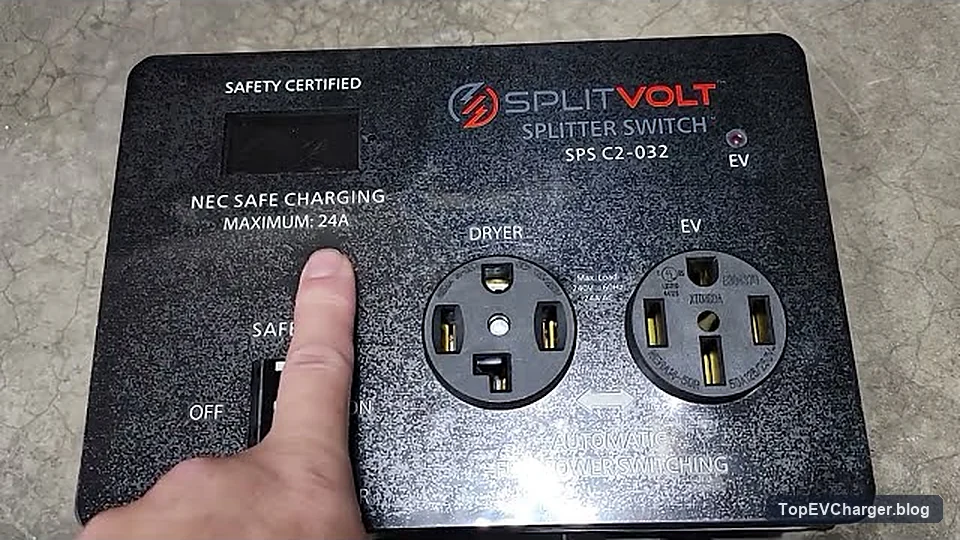
Electrical resistance and thermal buildup remain critical failure points in shared setups. Proper relay switching prevents terminal degradation during frequent daily power transfers under maximum continuous load.
Sharing a 240V laundry circuit requires precise load management to prevent breaker trips. NEC Article 210.23 prohibits continuous loads exceeding eighty percent of branch capacity.
Evaluating devices analyzed in our Splitvolt 24 Amp Level 2 EV Charger review demonstrates how automatic power switching safely prevents household breaker overloads on shared circuits.
- Prevents overcurrent trips by sequencing loads.
- Eliminates manual plug swapping hazards.
- Maintains standard NEMA receptacle integrity.
Circuit Capacity and Amperage Limits
Most residential laundry circuits operate at 30 amperes maximum capacity. Exceeding continuous duty thresholds risks tripping house breakers or damaging older wiring infrastructure.
Matching your vehicle's onboard charger draw to your splitter's rating ensures safe daily operations. Always verify your specific breaker sizing before connecting any high-draw charging equipment.
- Adheres to 80% continuous load rules.
- Protects legacy home wiring networks.
Splitvolt Architecture and Safety Protocols
Detailed findings in our Splitvolt portable EV charger review highlight how integrated overcurrent protection and UL-compliant components safeguard residential garage environments against thermal overload conditions.
The built-in display provides real-time voltage and amperage readings during active charging sessions. This gives users immediate feedback regarding electrical system stability and power draw.
Splitvolt units utilize integrated circuit breakers and built-in GFCI protection to safeguard users. The internal contactors switch both hot legs simultaneously for complete electrical isolation.
Firmware monitors line voltage drops and thermal anomalies directly at the plug face. If excessive resistance generates heat, the splitter trips to prevent melted receptacles or fire hazards.
- Integrated overcurrent protection breakers.
- Real-time LED status display panels.
- Compact, wall-mountable polymer enclosures.
Splitvolt Fault Detection Mechanisms
Automatic shutoff triggers prevent thermal runaway if unusual resistance is detected. This immediate fault response protects your home infrastructure from potential electrical fire hazards.
Resetting the unit after a fault requires manual intervention to verify safety conditions. Such safeguards ensure reliable long-term operational safety in residential garages.
- Immediate thermal fault response.
- Manual reset safety verification.
Dryer Buddy Custom Build Quality and Smart Relays
Dryer Buddy devices emphasize heavy-duty industrial relays and customizable internal configurations. Each unit is assembled to handle rigorous daily cycling without premature component wear.
When comparing options across our best EV level 2 charger guide, premium models often incorporate smart monitoring features that allow advanced users to track energy usage and control charging schedules remotely.
Custom built configurations allow users to select specific amperage ratings and receptacle types. Heavy duty industrial contactors handle thousands of switching cycles without contact welding failure.
Many variants integrate current sensing modules that communicate wirelessly with compatible charging hardware. This modular design gives advanced users unmatched control over power distribution schedules.
- Industrial-grade heavy-duty mechanical relays.
- Customizable plug and receptacle types.
- Optional smart monitoring capabilities.
Relay Mechanics versus Solid-State Switches
Mechanical relays produce an audible click when switching power between appliances. This physical separation ensures absolute circuit isolation when the dryer demands priority power.
Solid-state alternatives offer silent operation but require careful thermal management. Dryer Buddy prioritizes robust mechanical switching to ensure maximum reliability under load.
- Clear audible switching feedback.
- Robust physical circuit separation.
Installation Demands and Electrical Code Compliance
Both splitters require a properly grounded 240V NEMA receptacle near your laundry area. Professional installation by a licensed electrician ensures compliance with local electrical codes.
Inspecting your existing wall outlet for heat damage or corrosion is mandatory before plugging in splitters. Loose terminals create dangerous high-resistance connections under heavy loads.
Installing a splitter demands physical inspection of existing wiring gauge and breaker sizing. NEC compliance mandates that downstream loads never exceed the safe ampacity of old copper conductors.
Older homes featuring three wire laundry circuits lack dedicated earth grounds, creating major safety hurdles. Electricians must verify proper grounding to satisfy current National Electrical Code mandates.
- Requires grounded NEMA 10-30 or 14-30 outlets.
- Professional wiring inspection recommended.
- Strict adherence to National Electrical Code.
Verifying Ground Integrity
Older homes often feature three-prong outlets lacking dedicated equipment grounding conductors. Ensuring proper ground continuity protects against catastrophic electrical shock hazards during faults.
Modern four-prong configurations offer superior safety through separate neutral and ground paths. Always consult an expert if your receptacle wiring configuration appears outdated or suspect.
- Three-prong versus four-prong safety.
- Ground continuity verification.
Ergonomics, Enclosures, and Thermal Management
Managing heavy appliance cords requires sturdy mounting brackets and strain relief features. Both brands utilize robust enclosures designed to withstand accidental impacts and drops.
Effective thermal dissipation prevents internal components from overheating during multi-hour charging sessions. Proper airflow around the enclosure maintains optimal operating temperatures consistently.
Wall mounted splitter enclosures require sturdy mounting directly into studs to withstand heavy cable torque. Thermal management remains critical since continuous high current generates substantial internal housing heat.
Ergonomic placement prevents strain on fragile wall receptacles during frequent plug insertions. Robust polycarbonate housing protects sensitive internal electronics from garage dust, moisture, and accidental physical impacts.
- Durable wall-mounting anchor points.
- Strain-relief cable management designs.
- Impact-resistant outer plastic housings.
Cable Weight and Receptacle Stress
Heavy power cables exert downward mechanical force on wall-mounted splitter units. Utilizing proper wall brackets prevents receptacle damage and eliminates dangerous sagging cable connections.
Proper mechanical strain relief is also emphasized in our Chargepoint Home Flex review, where rigid installation practices protect wall outlets from premature physical wear and high-current electrical resistance.
- Reduces wall outlet mechanical strain.
- Prevents sagging cable hazards.
Daily Operation, Automation, and User Interfacing
Splitvolt prioritizes automated appliance priority, giving your laundry dryer precedence over EV charging. This prevents accidental circuit overloads without requiring manual switch adjustments.
Dryer Buddy variants offer flexible configurations including manual toggles or automated relay switching. Users can select models matching their specific daily lifestyle preferences.
Automated switching relies on priority logic that instantly routes power to active laundry appliances. Indicator lights provide clear visual feedback regarding circuit status and active power delivery.
Drivers appreciate seamless charging transitions without manually swapping heavy cables every single evening. Advanced setups allow integration with smart home platforms for scheduled overnight vehicle replenishment.
- Automatic appliance priority switching.
- Clear visual LED operational status.
- Zero manual intervention required daily.
Managing Dryer Priority Conflicts
When your dryer activates, the splitter instantly pauses EV charging to preserve circuit capacity. Charging resumes automatically once the dryer cycle finishes completely.
This seamless automation prevents frustrating tripped breakers while you sleep or handle household chores. Smart power sequencing protects your home electrical grid reliably.
- Automatic pause during laundry use.
- Seamless resume functionality.
Maintenance Schedules and Long-Term Durability
Routine maintenance involves inspecting plug prongs and receptacles for signs of discoloration. Catching thermal wear early prevents costly connector meltdowns over years of use.
Keeping contact surfaces clean ensures optimal electrical conductivity and minimizes heat generation. Proper care guarantees reliable multi-year service from your power splitter.
Routine inspections require checking plug terminals for discoloration or signs of thermal degradation. Preventative maintenance ensures secure pin connections and prevents high resistance faults from developing.
Over years of heavy cycling, mechanical relays may experience wear that requires professional replacement. Monitoring voltage stability helps detect failing components before catastrophic electrical failures occur.
- Periodic terminal temperature checks.
- Visual inspection for physical cracking.
- Dust-free enclosure cleaning routines.
Recognizing Component Wear and Tear
Signs of pitting or melting on plug pins indicate excessive electrical resistance. Replacing degraded cables immediately averts severe electrical safety hazards in your garage.
Investing in high-quality splitters reduces long-term maintenance risks through superior engineering standards. Durable internal components withstand thousands of connect cycles safely.
- Check plug pins for pitting.
- Monitor for terminal discoloration.
Frequently Asked Questions
Can I leave my electric vehicle plugged into a shared power splitter indefinitely without constant supervision?
Yes, both Splitvolt and Dryer Buddy are engineered for safe continuous overnight charging sessions, provided your home electrical infrastructure meets strict national electrical code standards. Continuous load safety depends entirely on professional installation and healthy wall receptacles.
Do these power splitters work with all standard residential electric vehicle chargers on the market?
They function seamlessly with any portable Level 2 EV charger matching your specific receptacle amperage rating and plug configuration. Equipment compatibility requires carefully verifying your mobile charger's maximum current draw against the designated splitter limitations.
What happens if my household laundry dryer turns on while my electric vehicle is charging?
Splitvolt and Dryer Buddy devices automatically pause the EV charging session to prevent dangerously overloading your home circuit breaker. Smart power prioritization safely resumes vehicle charging once the laundry appliance cycle finishes completely.
Can I install these power splitters myself without hiring a licensed electrician?
While they feature convenient plug-and-play designs, evaluating your home wiring for ground integrity and thermal health requires professional expertise. Electrical safety inspections protect your valuable residential property from hidden wiring faults and dangerous fire risks.
Which power splitter option is better suited for daily Tesla electric vehicle owners using garage setups?
Both popular brands accommodate Tesla mobile connectors using appropriate NEMA adapter plugs, but Splitvolt offers streamlined automatic switching. Tesla owners particularly appreciate automated load management for completely hassle-free overnight home refueling experiences.