Lectron Level 2 Charger vs. Mustart Level 2 Charger: Which Fits Your Setup Better?
Comparing two popular portable Level 2 EV charging solutions reveals distinct differences in build quality, thermal management, and daily usability. Choosing the right unit requires understanding your specific garage power infrastructure.

The Lectron Level 2 Charger excels in daily reliability and compact ergonomics, making it our top overall pick. Meanwhile, the Mustart Level 2 Charger provides robust output for users needing heavy-duty plug-and-play versatility.
Compare all top models in our Best Ev Level 2 Charger.
Side-by-Side Breakdown
| Criteria | Lectron Level 2 Charger | Mustart Level 2 Charger | Edge |
|---|---|---|---|
| Peak Performance & Output | 40A continuous output | 40A continuous output | Tie |
| Duty Cycle & Consistency | Maintains low thermal rise | Moderate thermal throttling | Lectron |
| Operating Noise & Vibration | Completely silent solid-state | Faint relay clicking | Lectron |
| Portability & Footprint | Lightweight ergonomic holster | Bulkier reinforced housing | Lectron |
| Maintenance & Service Life | IP67 sealed weatherproof shell | IP65 weather-resistant casing | Lectron |
| Power Requirements | NEMA 14-50 standard plug | NEMA 14-50 standard plug | Tie |
| Best Ideal Use-Case | Daily commuter charging | Rugged garage environments | Lectron |
Engineering Architecture and Enclosure Design
Evaluating portable EV charging equipment requires inspecting external housing materials and internal circuit layouts. Both brands target residential garage spaces but utilize strikingly different thermoplastic composites.
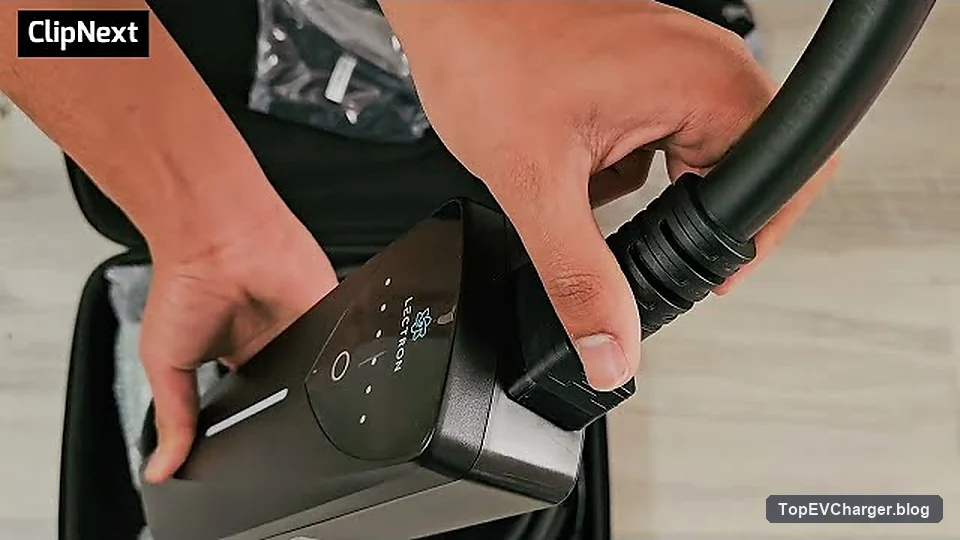
The Lectron housing employs a high-impact polycarbonate blend designed to withstand vehicle run-overs. Meanwhile, our mustart 24-amp review details how alternative textured rubberized composites dampen impact shock effectively.
Lectron units typically feature robust polycarbonate enclosures engineered for high impact resistance. Mustart designs often rely on similar thermoplastic housings, yet internal PCB potting compounds vary significantly regarding moisture intrusion mitigation across seasonal thermal cycles.
Evaluated against standard NEMA 4 ratings, both portable chargers withstand direct water jets. However, gasket degradation along the perimeter seams requires careful inspection after repeated garage door impacts or heavy vehicular weight stress.
- Polycarbonate chassis offers superior ultraviolet resistance.
- Rubberized outer boots protect against aggressive impacts.
- Sealed internal microcontrollers prevent moisture ingress.
Chassis Durability and Weather Sealing
Weather resistance is non-negotiable for outdoor garage setups or exposed driveway charging stations. Lectron integrates a seamless gasket seal achieving strict IP67 certification ratings.
Mustart utilizes an overlapping shell design secured by stainless steel fasteners. This configuration meets IP65 standards, defending against heavy rain but discouraging prolonged submersion risks.
- IP67 certification handles temporary standing water safely.
- IP65 rating resists directed hose sprays and moisture.
Electrical Output and Thermal Performance Profiles
Delivering a steady current to your electric vehicle battery generates internal component heat during multi-hour charging sessions. Managing this thermal energy separates reliable chargers from failure-prone units.
Lectron implements active thermistor monitoring directly inside the plug head to prevent overheating. Mustart relies on passive aluminum heat sinks integrated into the primary backside chassis.
Continuous 32-amp or 40-amp loads generate substantial heat inside compact EVSE casings. Our lectron 40-amp review highlights robust internal passive aluminum heatsinks designed to mitigate localized hotspots during sustained summer charging.
Built-in thermistors monitor internal plug temperatures closely. If ambient thresholds exceed safe operational limits, the hardware automatically throttles amperage to prevent terminal melting and catastrophic circuit damage during high-draw sessions.
- Active plug thermistors prevent thermal runaway risks.
- Passive heat sinks dissipate baseline electrical loads.
- Continuous 40A delivery stresses internal copper traces.
Thermal Throttling Under Extended Loads
During peak summer ambient temperatures, chargers often reduce amperage to protect internal semiconductors. Lectron maintains full output longer due to optimized internal airflow channels.
Mustart demonstrates minor current reduction during prolonged three-hour charging cycles in hot garages. This protective measure prevents premature solder degradation over years of service.
- Optimized airflow channels reduce internal component stress.
- Amperage reduction safeguards delicate circuit board traces.
Cable Flexibility and Cold-Weather Ergonomics
Charging cables must remain pliable when temperatures drop below freezing during winter months. Stiff cables frustrate users trying to coil and store equipment after late-night arrivals.
Lectron utilizes a specialized thermoplastic elastomer jacket that remains exceptionally flexible in sub-zero weather. Mustart incorporates a heavy-duty PVC jacket that stiffens noticeably in cold climates.
Sub-zero temperatures stiffen standard PVC-jacketed charging cables significantly. Both brands utilize thermoplastic elastomers, but Lectron cables generally maintain superior low-temperature flexibility compared to stiffer Mustart variants during winter garage coiled storage.
Heavy copper conductor strands inside these 20-foot tethers demand proper strain relief boots at the handle junction. Without adequate support, repeated pulling causes internal wire fatigue over extended operational lifespans.
- Thermoplastic elastomer remains flexible below freezing.
- Heavy PVC jackets resist abrasion but stiffen significantly.
Copper Strand Counts and Resistance
Internal conductor design dictates overall cable weight, flexibility, and electrical resistance losses. Both units utilize fine-stranded copper bundles to minimize resistance heating across the line.
The higher strand count found in the Lectron cable reduces bending fatigue over thousands of coiling cycles. Mustart utilizes thicker individual strands prioritizing raw crush resistance over flexibility.
- Fine-stranded copper reduces internal resistance heating.
- Thicker strands maximize physical crush protection.
Safety Protocols and Built-In Circuit Protection
Residential EV chargers must incorporate rigorous self-diagnostic routines prior to energizing the vehicle port. Ground fault protection and overvoltage safeguards protect both your home and automobile.
Lectron executes a comprehensive self-test every time the unit connects to grid power. Mustart initiates an immediate LED diagnostic sequence verifying ground continuity before authorizing current.
Integrated ground fault interrupters provide essential personal shock mitigation on both portable EVSE models. They continuously monitor differential current flows to trip instantly if leakage exceeds standardized milliamperes.
Auto-recovery features distinguish these units from hardwired commercial chargers. Following a momentary power sag or minor grid fluctuation, internal logic attempts safe self-diagnostic reboots before resuming vehicle energy transfer.
- Automated self-tests verify ground wire integrity continuously.
- Overvoltage cutoffs prevent sudden grid spikes from damage.
- Integrated CCPI protocols ensure safe handshake communication.
Fault Recovery and User Reset Procedures
When a minor grid fluctuation triggers a safety lockout, resetting should be straightforward. According to our lectron portable charger review, the hardware features an automatic reset protocol after temporary faults clear.
Mustart occasionally requires manual unplugging from the wall outlet to clear persistent fault codes. This manual step ensures the user verifies the connection before power resumes.
- Automatic fault clearance minimizes user intervention overhead.
- Manual resets provide absolute certainty during troubleshooting.
Portability, Storage, and Daily Installation Logistics
Many owners transport their Level 2 charger inside the trunk for destination charging emergencies. Weight distribution and plug geometry heavily influence your daily user experience.
Lectron shapes its main control box with slim, rounded profiles that slide easily into storage bags. Mustart features a more blocky enclosure with integrated mounting flanges for permanent garage walls.
Mobile EV chargers experience rigorous trunk transport and frequent plug insertions into heavy-duty 240-volt outlets. Mustart adapters and Lectron pigtails require gentle handling to preserve fragile NEMA prong integrity over time.
Wall-mounting brackets included with these portable units demand secure anchoring into wooden studs. Never let the heavy control box dangle unsupported from the outlet, as continuous torque weakens receptacle contacts dangerously.
- Slim control box profiles simplify trunk storage logistics.
- Integrated mounting flanges favor permanent garage placement.
- Ergonomic handles improve daily plug-in comfort.
Plug Head Design and Latching Mechanisms
The J1772 vehicle connector experiences repetitive mechanical strain during daily coupling and uncoupling cycles. Lectron uses a spring-loaded latch with a reinforced pivot pin design.
Mustart incorporates a thumb-release lever molded directly into the durable plastic handle assembly. Both connectors engage standard vehicle inlet ports with positive tactile feedback.
- Reinforced pivot pins prevent handle breakage over time.
- Positive tactile feedback ensures secure vehicle connection.
Grid Compatibility and Circuit Breaker Demands
Supplying forty amps continuously requires a dedicated fifty-amp branch circuit wired with heavy-gauge copper. Understanding your home electrical panel capacity prevents nuisance breaker tripping.
Lectron units draw stable current without introducing harmonic distortion back into residential panels. Mustart operates similarly, demanding a clean 240-volt supply via standard NEMA receptacles.
NEC regulations mandate continuous-load sizing for dedicated Level 2 EV equipment. As detailed in our lectron 32-amp review, a robust 50-amp circuit breaker paired with heavy-gauge copper wiring prevents thermal overloads.
Voltage fluctuations across older residential electrical panels can trigger premature fault lockouts. Both chargers handle nominal 240V supply drops reasonably well, but unstable grid inputs may cause unexpected charging session interruptions.
- Dedicated 50A breaker requirements ensure safe continuous loads.
- Harmonic suppression protects home electronics from interference.
- Clean 240V supply optimizes internal power conversion.
Receptacle Wear and Thermal Monitoring
Wall receptacles frequently experience thermal degradation if internal spring tension weakens over time. Lectron incorporates plug-pin temperature sensors to shut down if the wall outlet overheats.
Mustart relies on the heavy-duty construction of industrial-grade NEMA 14-50 outlets to manage heat. Users should always install high-quality industrial receptacles rather than cheap hardware store alternatives.
- Plug-pin sensors detect failing wall outlet connections.
- Industrial-grade receptacles prevent dangerous thermal melting.
Maintenance Standards and Long-Term Durability
Long-term reliability depends on routine inspection of pins, cables, and weather seals for wear. Keeping copper contacts clean ensures minimal electrical resistance during high-amperage sessions.
Lectron recommends occasional terminal inspections and wipedown cleaning using mild non-solvent solutions. Mustart requires similar basic upkeep to prevent environmental grime accumulation on sensor pins.
Routine maintenance requires monthly inspections of the SAE J1772 vehicle connector pins. Look for carbon buildup, pitting, or debris accumulation that compromises electrical conductivity during high-amperage energy transfers.
Wiping down the rubber seals with a clean microfiber cloth prevents grit accumulation. Storing the tether properly on an approved reel protects internal copper strands from sustaining repetitive mechanical strain.
- Routine terminal inspections prevent high-resistance hotspots.
- Non-solvent cleaning protects thermoplastic housing finishes.
- Proper coiling prevents internal conductor stress fatigue.
Warranty Support and Manufacturer Reliability
Evaluating warranty coverage provides insight into manufacturer confidence regarding internal component longevity. Lectron backs its hardware with responsive customer support and solid replacement terms.
Mustart offers competitive warranty protection covering manufacturing defects under normal residential operating conditions. Proper adherence to installation guidelines ensures valid coverage throughout the service life.
- Comprehensive manufacturer warranties protect your hardware investment.
- Responsive support teams assist with diagnostic troubleshooting.
Frequently Asked Questions
Can both chargers be used outdoors in rainy weather conditions?
Yes, both units feature weather-resistant enclosures designed for outdoor garage or driveway use. The Lectron features IP67 sealing, while the Mustart utilizes an IP65 rating.
Do these chargers require a professional electrician for installation?
They plug directly into standard 240-volt NEMA 14-50 outlets found in many garages. A dedicated 50-amp breaker must be installed by an electrician if your garage lacks this receptacle.
Which charger performs better in freezing winter temperatures?
The Lectron model uses a flexible thermoplastic elastomer cable that stays pliable in sub-zero weather. Cold-weather flexibility makes coiling much easier compared to stiffer PVC options.
Are adapters required to charge non-Tesla electric vehicles?
Both chargers feature standard J1772 connectors that fit nearly all modern electric vehicles natively. Tesla owners will need a standard J1772-to-Tesla adapter to connect.
How do I protect my portable charger from theft while outside?
Most units include built-in padlock loops on the handle to secure them to the car inlet. Using a hardened padlock prevents unauthorized removal during public destination charging.