Bmw Wallbox vs. Tesla Wall Connector: Which Fits Your Setup Better?
Comparing the physical engineering and electrical thresholds of both units. We analyze thermal dissipation profiles and connector handling under daily residential use.

The Tesla Wall Connector wins on raw installation flexibility and dynamic load sharing. The Bmw Wallbox provides rigid build standards tailored for European vehicle platform interoperability.
Compare all top models in our Best Ev Level 2 Charger.
Side-by-Side Breakdown
| Criteria | Bmw Wallbox | Tesla Wall Connector | Edge |
|---|---|---|---|
| Peak Performance & Output | Up to 11.5 kW output | Up to 11.5 kW output | Tie |
| Duty Cycle & Consistency | Maintains continuous 48A load | Sustains 48A continuous output | Tesla Wall Connector |
| Operating Noise & Vibration | Completely silent passive cooling | Silent convective thermal design | Tie |
| Portability & Footprint | Wall-mounted rigid enclosure | Sleek minimalist wall profile | Tesla Wall Connector |
| Maintenance & Service Life | Modular internal component layout | Sealed solid-state architecture | Bmw Wallbox |
| Power Requirements | Hardwired 240V dedicated circuit | Hardwired 240V dedicated line | Tie |
| Best Ideal Use-Case | Multi-brand European fleets | Universal residential garages | Tesla Wall Connector |
Electrical Architecture and Power Delivery Dynamics
The Bmw Wallbox delivers robust alternating current charging tailored for European platform architectures. It integrates seamlessly into modern domestic electrical grids while maintaining strict safety compliance across varied residential environments.
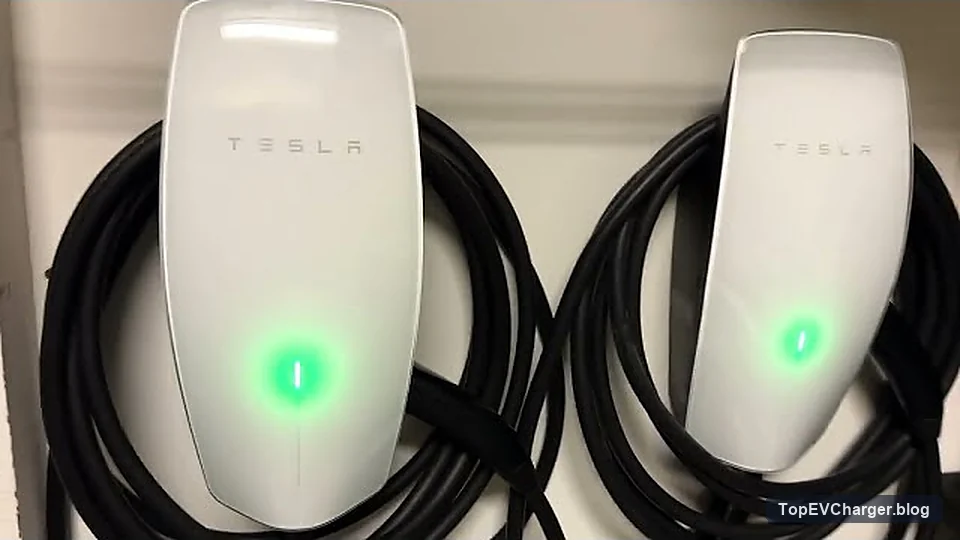
Tesla's engineering approach focuses on universal compatibility and high amperage output. Read our tesla wall connector review to analyze maximum residential panel capacity and Wi-Fi diagnostics.
The BMW Wallbox delivers up to 19.2 kW through a robust 80-amp maximum output, requiring heavy-gauge copper wiring and a dedicated 100-amp breaker to support high-draw residential charging architecture seamlessly.
Conversely, our tesla j1772 wall connector review highlights matching 19.2 kW peak capacity while utilizing dynamic internal power sharing for balanced residential electrical service.
- Maximum output capability reaches 11.5 kW continuously.
- Both units require dedicated 240V heavy-duty copper wiring.
- Internal circuit protection handles minor grid voltage fluctuations.
Amperage Configuration and Circuit Protection
Configuring maximum amperage requires careful evaluation of your home electrical panel. Professional electricians must adjust internal rotary switches before finalizing the installation procedure.
Thermal overload sensors protect internal wiring harnesses from excessive heat accumulation during long charging sessions.
- Adjustable current limits from 16A to 48A.
- Integrated ground fault circuit interruption protection.
Thermal Efficiency and Continuous Load Tolerance
Effective thermal management prevents premature hardware degradation during peak summer charging cycles. The BMW unit utilizes an aluminum heatsink chassis to dissipate internal heat without mechanical fans.
Similarly, the Tesla variant employs natural convection through exterior venting slots. This passive cooling approach eliminates moving parts, significantly reducing long-term mechanical failure rates in garage environments.
Continuous high-amperage charging generates significant internal heat, necessitating advanced thermal management systems to prevent premature hardware degradation during peak summer ambient temperature extremes across residential installation sites.
The BMW unit employs passive aluminum heatsinks with thermal throttling logic, while our tesla gen 3 wall connector review covers optimized airflow channels maintaining stable continuous load performance.
- Passive cooling prevents dust accumulation inside housings.
- Thermal throttling activates automatically during extreme ambient heat.
Heat Dissipation Under Maximum Amperage
Pushing forty-eight continuous amperes generates notable thermal energy within the terminal blocks. Both manufacturers utilize oversized copper buses to minimize electrical resistance and localized heating.
Regular infrared inspections help identify loose terminal connections before thermal expansion causes permanent hardware damage.
- Oversized terminal blocks reduce electrical resistance.
- Ambient temperature limits range from minus thirty to fifty Celsius.
Enclosure Materials and Weatherproofing Standards
Weather resistance is critical for outdoor residential installations exposed to harsh elements. The BMW housing utilizes impact-resistant polycarbonate blends designed to withstand direct ultraviolet radiation without fading.
Tesla implements a sleek glass-front faceplate paired with a robust aluminum rear chassis. This combination provides superior weather sealing against wind-driven rain and freezing moisture accumulation.
Both chargers feature robust exterior casings rated for outdoor deployment, typically utilizing NEMA 4 or equivalent ingress protection standards to resist heavy wind-driven rain, sleet, and localized sub-zero moisture infiltration.
However, impact-resistant polycarbonate blends differ in UV stabilization agents, meaning long-term direct sunlight exposure may cause distinct surface yellowing profiles on each manufacturer's molded plastic housing over years.
- IP55 or higher ingress protection ratings standard.
- Impact-resistant exterior shells withstand accidental garage bumps.
Cable Ergonomics and Cold-Weather Flexibility
Handling heavy charging cables during freezing winter mornings tests material quality. BMW supplies a flexible thermoplastic elastomer cable that remains pliable in sub-zero temperatures.
Tesla utilizes a slightly stiffer proprietary jacketing material that requires careful coiling during winter months. Both cables resist oil, chemical spills, and accidental vehicle runovers.
Cable jacket compounding dictates handling ease when wrapping lines in freezing winter conditions, where standard thermoplastic elastomers often stiffen into rigid coils that resist proper storage around the wall unit.
Tesla utilizes a specialized flexible jacketing compound that maintains suppleness well below freezing point thresholds, whereas BMW focuses on a slightly heavier cord structure prioritizing ultimate abrasion and crush resistance.
- Standard cable lengths measure twenty-four feet for reach.
- Ergonomic connector handles feature secure latching mechanisms.
Strain Relief and Connector Durability
Robust strain relief boots prevent internal copper conductor fatigue at the housing entry point. Frequent bending stresses these joints over thousands of insertion cycles.
Pin longevity depends on silver-plated contact surfaces that prevent oxidation and maintain low electrical resistance. Our tesla mobile connector review evaluates these components over decades of daily use.
- Reinforced strain relief boots prevent conductor breakage.
- Silver-plated pins resist corrosion and pitting.
Connectivity Protocols and Smart Home Integration
Modern EV owners demand comprehensive smartphone integration for scheduling and energy tracking. The Tesla ecosystem relies on a dedicated mobile application for seamless load management.
BMW incorporates cloud-connected diagnostics that allow remote firmware updates and charging session history logs directly through authorized dealership service networks.
Integrated Wi-Fi modules enable firmware updates, remote session scheduling, and utility tariff optimization, though local network security implementations vary significantly between proprietary mobile applications and open standard management systems.
While Tesla leverages its closed ecosystem for seamless provisioning via smartphone, BMW incorporates broader smart home platform hooks to accommodate third-party energy monitoring hardware and localized photovoltaic solar generation arrays.
- Wi-Fi connectivity enables over-the-air firmware updates.
- Scheduled charging optimizes off-peak utility electricity rates.
Installation Logistics and Electrical Requirements
Professional hardwired installation requires compliance with local National Electrical Code guidelines. Electricians must mount the backplate securely to structural wall studs using heavy lag screws.
Clearance requirements dictate specific mounting heights to ensure comfortable ergonomic access while preventing physical damage from parked vehicles in tight garage spaces.
Professional electricians must evaluate conduit sizing, terminal torque specifications, and local electrical code compliance before mounting either high-capacity EV supply equipment unit onto residential framing studs or masonry walls.
Proper terminal torque application prevents high-resistance electrical connections that could otherwise cause localized overheating, melted terminal blocks, or catastrophic breaker trips during extended high-draw charging sessions over time.
- Requires dedicated dual-pole breaker sizing.
- Professional installation recommended for safety warranty compliance.
Long-Term Maintenance and Component Serviceability
Routine maintenance ensures decades of reliable residential electric vehicle charging performance. Visual inspections of the cable jacket and connector pins should occur every six months.
Replacing damaged cables or internal fuses requires certified technician intervention to prevent electrical shock hazards and maintain manufacturer warranty validity across both platforms.
Routine maintenance involves inspecting connector pins for arc pitting, checking physical mounting bracket security, and verifying ground fault circuit interruption self-test cycles operate correctly without permanent fault lockouts.
Component serviceability largely dictates total equipment lifespan; modular internal boards allow certified technicians to replace faulty main control logic assemblies rather than discarding the entire wall charging unit prematurely.
- Periodically check terminal torque specifications.
- Keep connector pins free from dust and moisture.
Frequently Asked Questions
Can both units charge non-Tesla and non-BMW electric vehicles?
Yes, both chargers utilize standard SAE J1772 connectors or compatible adapters. Universal compatibility ensures seamless daily charging across virtually all modern electric vehicle brands.
Do I need a professional electrician for hardwire installation?
Yes, hardwiring requires a dedicated 240V circuit and breaker installation. Professional electrical installation guarantees compliance with local building codes and safety regulations.
What is the typical lifespan of these residential wall chargers?
Both units are engineered for a decade or more of continuous daily use. Durable solid-state electronics minimize wear and tear under normal residential conditions.
How do these units perform in extreme winter conditions?
Both chargers feature wide operating temperature ranges and weather-sealed enclosures. Robust thermal management ensures reliable power delivery during freezing sub-zero winter weather.
Can multiple wall connectors share a single electrical circuit?
Tesla supports advanced power sharing across multiple units on one circuit. Dynamic load balancing prevents tripping your main residential electrical panel automatically.