40 Amp vs. 50 Amp Breaker Ev Charger: Which Fits Your Setup Better?
Choosing the right home charging setup requires balancing electrical capacity with daily driving demands. Understanding the national electrical code continuous load rule ensures safe, reliable operation.


The 50 amp breaker setup wins for faster overnight replenishment and future-proofing. However, the 40 amp option provides exceptional reliability for standard daily commuters with constrained panels.
Compare all top models in our Best Ev Level 2 Charger.
Side-by-Side Breakdown
| Criteria | 40 Amp | 50 Amp Breaker Ev Charger | Edge |
|---|---|---|---|
| Peak Performance & Output | 32-amp continuous delivery (7.7 kW) | 40-amp continuous delivery (9.6 kW) | 50 Amp Breaker Ev Charger |
| Duty Cycle & Consistency | Excellent continuous thermal stability | Higher throughput with robust thermal management | 50 Amp Breaker Ev Charger |
| Operating Noise & Vibration | Silent passive cooling operation | Silent passive cooling operation | Tie |
| Portability & Footprint | Compact enclosure with flexible wiring | Slightly larger chassis to dissipate heat | 40 Amp |
| Maintenance & Service Life | Minimal terminal stress over time | Engineered for heavier daily thermal cycling | 50 Amp Breaker Ev Charger |
| Power Requirements | Requires a dedicated 40-amp breaker | Requires a dedicated 50-amp breaker | 40 Amp |
| Best Ideal Use-Case | Standard plug-in hybrid or moderate daily commute | Long-range battery electric vehicles and fast turnarounds | 50 Amp Breaker Ev Charger |
Decoding the National Electrical Code Continuous Load Rule
Residential electric vehicle supply equipment operates under strict safety guidelines established by electrical authorities. The eighty percent rule dictates that continuous loads cannot exceed eighty percent of a circuit breaker rating.
When designing your garage power supply, safety margins prevent overheating inside residential service panels. Operating any circuit near maximum capacity requires verified wire sizing and high-grade thermal breakers.
Understanding this arithmetic prevents costly electrical failures and ensures your hardware operates within safe thermal limits. Every installation must account for ambient garage temperatures and potential voltage drop over distance.
The National Electrical Code classifies electric vehicle supply equipment as continuous loads. This means your circuit must handle maximum current draw for three hours or longer without tripping the overcurrent protection device.
Reviewing what size breaker for 48 amp ev charger calculations ensures your installation complies with continuous load codes. Circuits require sizing at 125 percent of the maximum nameplate rating to prevent faults.
Ignoring this continuous load rule causes excessive thermal expansion in panel breakers. Over time, terminal degradation melts insulation, triggering nuisance faults and creating severe electrical fire hazards inside residential service panels.
- Continuous loads demand strict adherence to national safety codes.
- Eighty percent capacity protects residential electrical panels from overheating.
- Temperature ratings on wire insulation dictate safe maximum current flow.
Mathematical Breakdown of Circuit Capacity
Calculating precise output requires multiplying your circuit breaker rating by zero point eight. A forty amp breaker safely delivers a maximum continuous output of thirty two amps to your vehicle.
Scaling up to a fifty amp circuit yields a maximum continuous output of forty amps. This extra eight amp difference translates into significantly faster energy delivery during overnight charging sessions.
- Forty amp breaker limits continuous draw to thirty two amps.
- Fifty amp breaker permits a continuous draw of forty amps.
Actual Delivered Output and Real-World Charging Speeds
Consult our what size breaker for 32 amp ev charger guide to properly configure your supply hardware. Delivered kilowatt output directly dictates how quickly your battery pack regains usable daily driving range.
Stepping up to a forty amp continuous delivery yields roughly nine point six kilowatts of power. This higher throughput recovers more miles of driving range during standard off-peak utility hours.
Vehicle onboard chargers also dictate maximum acceptance rates, meaning your car dictates the actual intake. Matching your supply equipment capacity to your vehicle specifications prevents wasted electrical infrastructure investments.
A forty-amp breaker delivers a maximum continuous output of thirty-two amperes. At two hundred forty volts, this translates to seven point six kilowatts, adding roughly thirty miles of range per hour of charging.
Conversely, a fifty-amp breaker supplies a continuous output of forty amperes. Operating at standard residential voltage, it yields nine point six kilowatts, increasing replenishment rates to nearly thirty-seven miles hourly.
Real-world delivery speeds depend heavily on onboard charger limits. If your vehicle maxes out at seven point six kilowatts, upgrading past a forty-amp circuit yields zero charging speed improvements whatsoever.
- Kilowatt output determines hourly range replenishment rates.
- Higher amperage yields faster recovery during off-peak hours.
- Onboard vehicle chargers limit maximum possible energy intake.
The Overnight Range Recovery Comparison
Most drivers rely on overnight charging windows to replenish daily energy consumption easily. A standard thirty two amp supply recovers about thirty miles of range per hour of charging.
Utilizing a forty amp continuous supply increases that recovery rate to roughly thirty seven miles per hour. Over an eight hour window, this variance becomes a substantial difference in total range.
- Thirty two amp supply adds roughly thirty miles per hour.
- Forty amp supply increases recovery to thirty seven miles per hour.
Circuit Infrastructure and Conductor Gauge Realities
Electrical infrastructure requirements change dramatically when stepping between these two common circuit sizes. Conductor sizing must match the ampacity ratings mandated by local building codes and fire safety regulations.
Installing a forty amp circuit typically permits the use of eight gauge copper wiring inside standard conduit. Longer garage runs may require sizing up conductors to combat electrical resistance and voltage drop.
Choosing a fifty amp circuit invariably requires heavier six gauge copper wiring to handle the load safely. Heavier conductors increase installation material costs and require larger knockouts in service panels.
Installing a forty-amp circuit typically requires six gauge copper NM-B or THHN wire run through approved conduit. Aluminum wiring demands larger gauges to compensate for higher electrical resistance and thermal expansion rates.
A fifty-amp circuit running longer distances often necessitates upgrading to four gauge copper to minimize voltage drop. Excessive line loss generates heat and reduces overall system efficiency during extended overnight sessions.
Conduit fill capacity and ambient temperature ratings dictate maximum conductor ampacity. Electricians must consult NEC tables to apply correction factors when routing cables through unconditioned attics or exterior wall conduits.
- Conductor gauge must strictly match local electrical building codes.
- Forty amp circuits commonly utilize eight gauge copper wire.
- Fifty amp circuits require heavier six gauge copper conductors.
Panel Capacity and Service Load Calculations
Before adding any high draw equipment, your electrician must perform a complete load calculation. Older residential panels featuring one hundred amp service might lack capacity for heavy EV charging loads.
Checking our what size breaker for 40 amp ev charger guide helps you verify electrical service capacity. Upgrading your home panel safely prevents nuisance breaker trips and potential fire hazards.
- Professional load calculations prevent main service panel overloads.
- Older one hundred amp panels often require costly electrical upgrades.
Hardwired Versus Plug-In Installation Dynamics
Installation methodology heavily influences the long-term reliability and safety of your charging hardware. Hardwired units eliminate vulnerable mechanical connection points found inside standard wall receptacles and heavy-duty plugs.
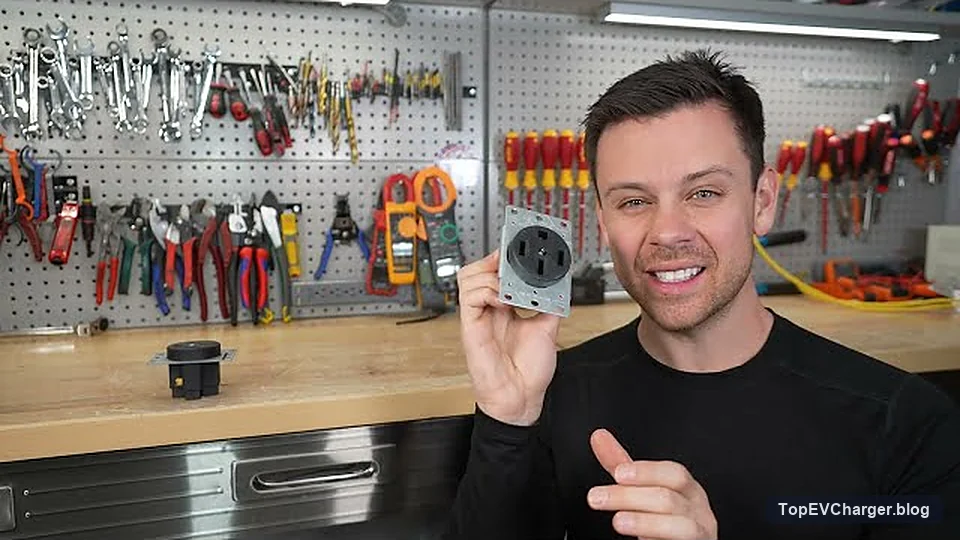
Plug-in units offer convenient portability if you move or prefer swapping charging hardware later. However, plug-in installations requiring a NEMA fourteen fifty receptacle mandate expensive GFCI breakers per modern electrical codes.
Hardwired configurations bypass the need for expensive receptacle GFCI breakers while providing permanent weather resistance. Permanent wiring connections significantly reduce high resistance contact failures over years of heavy daily use.
Hardwiring eliminates potential failure points by removing mechanical NEMA receptacles. Direct wire connections accommodate higher torque specifications, ensuring superior physical contact and preventing terminal oxidation over years of heavy cycling.
Plug-in units utilize NEMA fourteen-fifty outlets, which require mandatory GFCI breakers per current electrical codes. These heavy-duty receptacles degrade faster under constant insertion strain and sustained thermal cycling loads.
National electrical codes mandate torque screwdrivers for terminal block installations. Proper torque prevents loose connections that create high resistance micro-arcs, safeguarding your home electrical grid against premature component failure.
- Hardwired units eliminate vulnerable plug and receptacle connection points.
- Plug-in models offer convenient portability for future relocation needs.
- Receptacle installations mandate expensive GFCI circuit breakers by code.
Thermal Stress at Plug Receptacles
Heavy electrical currents generate substantial heat across mechanical contact points inside wall receptacles. Industrial-grade receptacles are mandatory for continuous loads to prevent melting plastic housings and terminal degradation.
Hardwired connections utilize secure terminal blocks that distribute clamping pressure evenly across conductors. This robust engineering drastically minimizes the risk of thermal runaway during long multi-hour charging sessions.
- Continuous currents generate significant heat at receptacle terminals.
- Industrial-grade hardware prevents catastrophic thermal degradation issues.
Thermal Management and Long-Term Hardware Durability
Internal thermal management dictates how well charging hardware handles years of demanding daily cycles. High-output electronics generate substantial internal heat that must be safely dissipated away from sensitive microprocessors.
Reviewing a what size breaker for 16 amp ev charger guide shows how lower amperage reduces thermal strain. Manufacturers utilize heavy aluminum heat sinks to protect internal circuitry from premature failure.
Units running on forty amp circuits experience slightly lower thermal stress during extended sessions. This reduced operating temperature can extend the overall service life of relays, contactors, and internal sensors.
High-amperage EV charging generates intense localized heat within charger enclosures and plugs. Advanced units utilize internal thermistors to monitor operating temperatures, automatically throttling current if internal components approach critical thermal thresholds.
Selecting a forty-amp setup over a fifty-amp configuration reduces sustained thermal stress on internal relays. Lower current demands extend the operational lifespan of capacitors, contactors, and printed circuit board traces.
Routine maintenance involves inspecting plug blades and terminal screws annually. Removing dust accumulation and checking for discoloration ensures optimal current flow and prevents catastrophic thermal runaway in garage environments.
- Internal thermal management protects sensitive charging microprocessors.
- Higher amp circuits push electronic components closer to thermal limits.
- Lower thermal stress can extend overall equipment service life.
Enclosure Design and Environmental Resilience
Garage environments expose charging equipment to severe temperature fluctuations, dust, and moisture infiltration. Premium enclosures feature weatherproof NEMA ratings designed to withstand harsh elements without degrading internal components.
Proper airflow around the exterior chassis prevents localized heat pockets from forming inside enclosures. Selecting a unit with adequate thermal headroom ensures consistent performance during peak summer heatwaves.
- Weatherproof NEMA ratings protect electronics from garage humidity.
- Exterior chassis airflow prevents damaging localized heat pockets.
Matching Electrical Capacity to Your Specific Driving Habits
Selecting the ideal charging speed depends entirely on your daily commuting distance and routine. Drivers with modest commutes rarely require the maximum throughput of a heavy fifty amp circuit.
Conversely, households sharing one charger between multiple electric vehicles benefit immensely from faster speeds. Maximizing your overnight charging window ensures every vehicle starts each morning with a full battery.
Evaluating your true daily mileage prevents spending extra money on unnecessary panel upgrades. Consulting with a licensed electrician helps determine the absolute best infrastructure balance for your home.
Average American commuters drive roughly forty miles daily, meaning a forty-amp circuit easily replenishes daily energy use during a standard overnight window. Higher amperage becomes redundant for typical daily driving profiles.
Multi-EV households or drivers with extreme daily commutes benefit greatly from fifty-amp circuits. Faster replenishment rates ensure complete battery recovery during off-peak utility hours, optimizing electricity rate structures.
Evaluate your utility provider time-of-use rate schedules before finalizing infrastructure choices. Slower chargers might miss narrow discount windows, whereas higher amperage output guarantees full recovery during cheaper electricity hours.
- Daily commuting distance dictates your actual charging speed requirements.
- Multi-vehicle households benefit greatly from faster charging throughput.
- Professional electrician consultations prevent unnecessary home panel upgrade expenses.
Future-Proofing Your Home Electrical Infrastructure
As automotive battery packs grow larger, charging infrastructure demands increase across residential neighborhoods. Installing heavy infrastructure today prevents the hassle of rewiring your garage when upgrading vehicles later.
Investing in a robust fifty amp circuit provides valuable headroom for future high-capacity EVs. This foresight ensures your home charging setup remains relevant for upcoming automotive technological advancements.
- Growing automotive battery capacities demand robust residential charging infrastructure.
- Installing heavy wiring today prevents costly future garage remodels.
Frequently Asked Questions
Can I install a 50 amp charger on existing 40 amp wiring?
No, you cannot safely run a fifty amp continuous load on undersized forty amp wiring. Doing so violates electrical safety codes and creates a severe risk of fire hazards from overheating conductors.
Do I really need a professional electrician for these installations?
Yes, high-voltage residential electrical work requires professional expertise and local building permits. Licensed electricians ensure your panel load calculations and breaker sizing comply with strict national safety standards.
Which setup is better for my home's electrical panel longevity?
The forty amp setup places slightly less continuous thermal stress on your service panel components. However, a properly installed fifty amp circuit remains completely safe when using premium commercial-grade hardware.
Will a 50 amp charger charge any electric vehicle much faster?
It depends entirely on your vehicle onboard charger acceptance limit capabilities. Many standard plug-in hybrids and smaller EVs cannot accept the maximum power output offered by larger circuits.
Is hardwiring always recommended over using a plug-in connection?
Hardwiring is generally preferred because it eliminates vulnerable mechanical plug and socket connection points. This permanent connection significantly reduces resistance heating over years of heavy daily charging use.